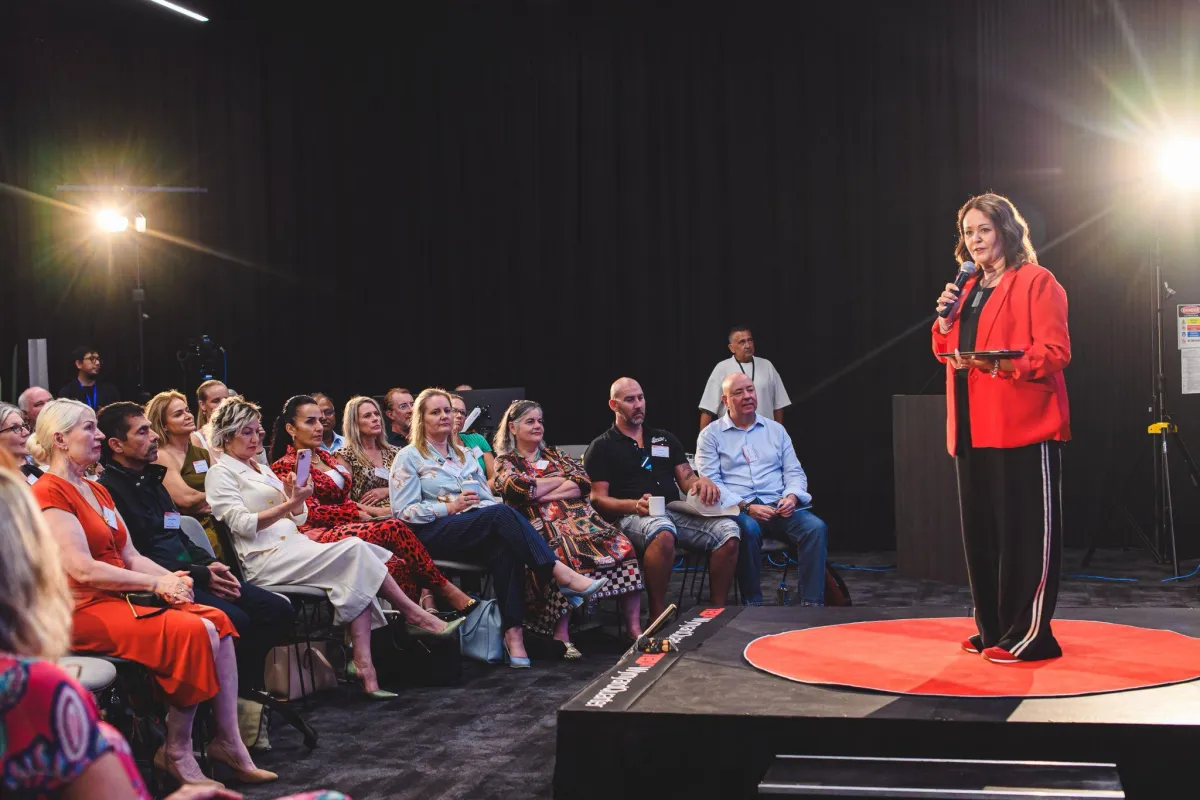
The Real ROI of a Keynote Is What People Do Next
I’ve never believed the value of a keynote lives in the room.
It’s not the applause.
It’s not the slides.
It’s not even the standing ovation.
It’s what happens next.
It’s the conversation someone has over coffee afterwards.
It’s the leader who speaks up differently in the Monday meeting.
It’s the quiet person who finally shares an idea they’ve been holding onto for months.
It’s the moment someone backs themselves and says, “You know what, I can do this.”
That’s the real return on investment.
Because information doesn’t change behaviour.
Emotion does.
And emotion is what stories are built for.
People don’t remember slides. They remember how they felt.
Think about the last conference you attended.
Be honest.
You probably don’t remember the five-step framework.
You probably don’t remember the statistics.
But I guarantee you remember a moment.
A story.
A laugh.
A sentence that hit you right in the chest.
A speaker who made you feel seen.
That’s not accidental.
When we feel something, our brain pays attention. Memory gets stronger. Meaning gets attached. Action becomes more likely.
Neuroscience tells us that emotion helps encode memory.
In plain English, that means this:
If people feel it, they keep it.
And if they keep it, they use it.
That’s where change begins.
Story beats information every time
I love great content. I love practical tools. I love giving people things they can apply immediately.
But here’s what I know after years on stages and in rooms with teams and leaders.
Information fills notebooks.
Stories change behaviour.
You can give someone ten tips on communication and they might remember one.
Tell them one honest story about a time you got it wrong, what you learned, and how you grew, and they’ll remember it for years.
Because stories don’t just teach.
They model.
They say, “Here’s what this looks like in real life.”
They give people permission.
Permission to try.
Permission to speak.
Permission to lead.
That’s why story-based keynotes consistently outperform information-heavy ones.
Not because they’re more entertaining.
Because they’re more human.
The ripple effect leaders often miss
When I work with organisations, I sometimes ask this question a few weeks after an event:
“What stories are your people repeating?”
Not what slides they liked.
Not what notes they took.
What stories are they telling each other?
Because that’s the real metric.
If someone says,
“Remember that story about backing yourself?”
or
“I keep thinking about what she said about clarity over complexity…”
That’s culture shifting.
Language is changing.
Behaviour is changing.
That’s ROI.
A keynote isn’t just a moment. It’s a spark.
And sparks travel.
They show up in:
Team conversations
Performance reviews
Sales calls
Leadership decisions
The way someone handles pressure
The way someone holds themselves in a room
You don’t always see it immediately.
But you feel it.
The room feels different.
More connected.
More confident.
More aligned.
So what should leaders actually look for?
If you’re booking a speaker, or leading an event, here’s how I think about impact.
Not “Did they like it?”
But:
Are people talking differently?
Are they showing up differently?
Are they taking more ownership?
Are they backing themselves more?
Are they connecting with each other more openly?
Because leadership isn’t built in big, dramatic moments.
It’s built in small, everyday choices.
A conversation handled better.
A braver question asked.
A clearer message delivered.
A team that trusts each other just a little more.
Those micro-moments compound.
And that’s where transformation happens.
My measure of success
After every keynote, I don’t ask myself, “Did they clap?”
I ask:
Did something shift?
Did I see shoulders drop?
Did I see people nodding because they felt understood?
Did someone come up afterwards and say, “I needed to hear that”?
Because if even one person walks away and does something differently tomorrow, the keynote worked.
If a leader communicates with more clarity.
If a team connects more deeply.
If someone finds the courage to use their voice.
That’s impact.
And impact is the only ROI I care about.
Because a great keynote doesn’t just fill time in a programme.
It changes what people do next.
